un film documentaire réalisé par Vonnick Ribéraud
The project
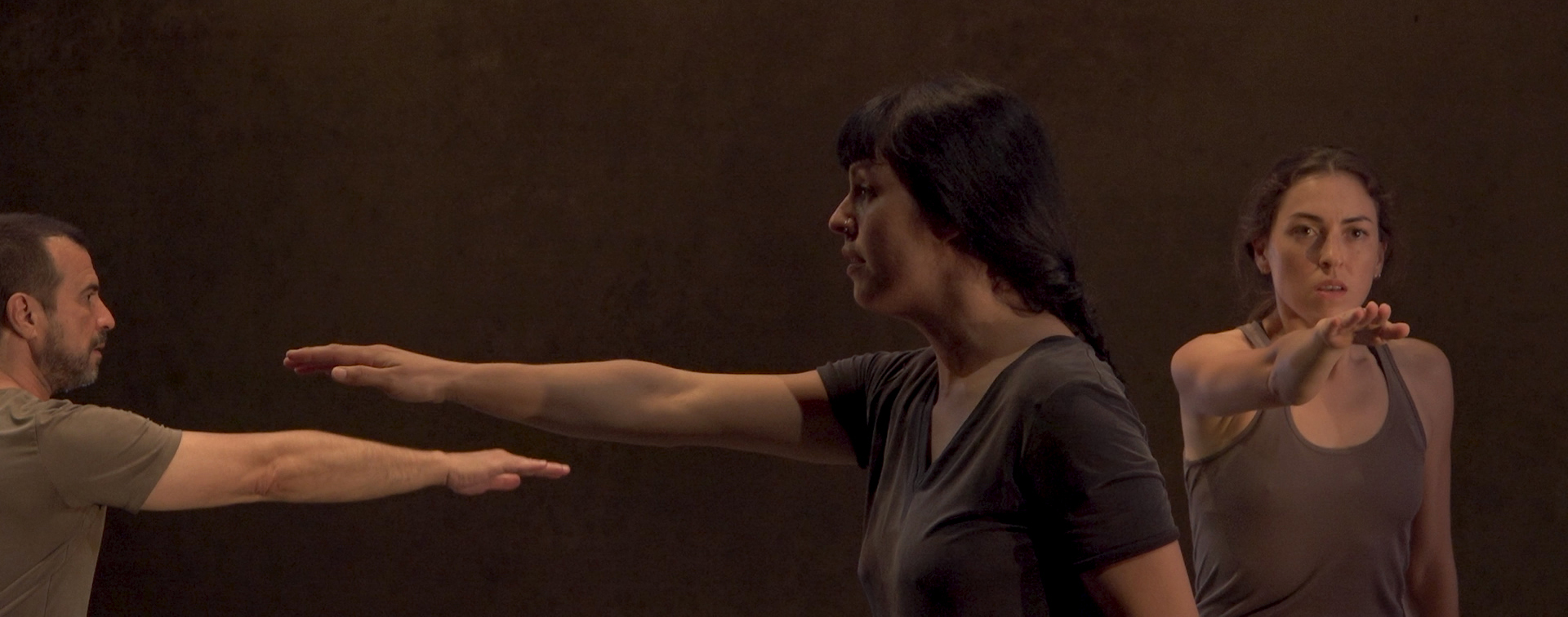
For her first documentary Vonnick Ribéraud decided to explore the question of corporeal liberation by following the work of a physical theater company : the Hippocampe company. With the aim of continuity and transmission, the group of actors reconstructs the repertoire of Etienne Decroux, the creator of corporeal mime. Actors have to face a demanding discipline which, owing to its technicality, can quickly constrain the body to the point of making it forget the creative aspect of the art. But for all that, from a certain stage in the life of the actor, it ends up giving way to corporeal liberation. In this digital age, “Naked and Nothing” focuses on the body and the expression of its materiality through the prism of an art that gives us a new interpretation.
Interview with the director
How did the project emerge ?
The prep work started at the end of 2018, when I met Thomas Leabhart, the former teacher of Luis Torreão but also a former student of Etienne Decroux. I had the impression, watching him teach, to see directly the heritage of Etienne Decroux, the designer of this artistic practice. As if a bit of him was conveyed and also perpetuated in addition to the gestures. It also seemed important to make a documentary on this practice and on its potential, this liberating force that I had already perceived ten years ago when I myself took body mime lessons with Luis Torreão.
How was the shooting ?
The shooting took place in several stages. After filming a summer internship, led by Thomas Leabhart, I had the opportunity to film a research workshop for several months. This workshop led to a project to recompose and stage the figures of Etienne Decroux which took place behind closed doors, in a theater in the Paris suburbs. Set up by Luis Torreão, this project consisted of replaying the repertoire of Etienne Decroux in order to transmit it and make it accessible to as many people as possible.
At the time of editing, why did you favor the rushes shot in the theater ?
At the end of this shoot, it seemed to me that I had enough rich material to base the whole documentary on. The central question, which is that of corporeal liberation, then arose. How to show it? It seemed to me undeniable that it had to partly go through the story of the actors. After conducting interviews with them, it turned out that their confidences are both rare, precious and very intimate.
In addition to confiding in their own feelings, they come back to the way they learned the discipline, both the joy and the difficulty of it. Thanks to their stories, we get to understand the stages through which they went and, despite the tension caused by the requirement of this apparently rigorous practice in certain aspects, all of them lead us towards a form of corporeal liberation.
Of what nature is this bodily liberation, permitted by corporeal mime ?
The corporeal mime was for me an overwhelming discovery, both from an aesthetic, sensory and human point of view. Absolute benevolence reigns in the courtyards, the bodies move and come into contact with consideration, and the search for movement frees the body and the imagination.
Body exploration as it is carried out in these courses allowed me to access a new territory of myself and made me realize how much a lack of consideration towards our bodies reigned in our society. We ask him to be beautiful, to be efficient, in good health, but what he really lives, what he feels, his creative potential, all that matters little.
On the intimate level, the body is often considered as something that is there, that is part of us, we no longer really pay attention to it, it is so familiar to us. But what does it tell us? Experiencing the body differently, here through the practice of corporeal mime, is an opportunity to break away from this familiarity and comprehend it differently. We can deconstruct the body as we deconstruct ideas.
The body has a language of its own and which, in a way still different from speech, touches on the intimate and the emotional. Beyond the culture and the time in which the body lives and evolves and therefore the environment in which its language is created, the body expresses an experience, a sensitivity, a way of being in the world and in relation to it.
Etienne Decroux, having created his own body language, opened up the possibility of expressing himself according to a certain code. Following this, this familiarity with the body is broken and the learning of this new gesture, long and sometimes tedious, leads the artist to raise awareness of his body and to see it differently. Subsequently, the artist ends up reclaiming this language in his own way to make it his own.